
Paid Media
Email Is More Than a Retention Tool. It's a Revenue Machine. Here's the Difference.
If your email revenue is below 20 percent of total revenue, it is an execution problem. Not a channel problem.
.png)
If your email revenue is below 20 percent of total revenue, it is an execution problem. Not a channel problem.

Ask most ecommerce brands what email is for and they'll tell you it's for retention. Keep existing customers engaged. Send a discount when someone hasn't bought in a while. Run a campaign around Black Friday. Maybe a welcome sequence for new subscribers.
This is not wrong. But it's incomplete in a way that leaves a significant amount of revenue on the table.
Email, when built properly, is not a retention channel bolted onto the back of your acquisition strategy. It's a revenue engine that works across the entire customer journey, from the moment someone first encounters your brand to the point where they become a high-value repeat buyer. The brands that understand this build email programs that often drive 20 to 30 percent of total revenue. The ones that don't leave it as an afterthought and wonder why their numbers are lower than their peers.
The retention framing creates a specific set of problems. It positions email as something that activates after acquisition, which means it's always playing catch-up with paid media rather than working alongside it. It focuses attention on existing customers at the expense of new ones. And it encourages a campaign-heavy approach, send a promotion, watch the revenue spike, repeat, that produces short-term numbers but doesn't build long-term value.
Retention is a legitimate goal. But it's one function of a properly built email program, not the whole thing.
A retention-only email program asks, “How do we get past customers to buy again?”
A revenue-focused email program asks a bigger question: “How do we use email to capture more intent, convert more first-time buyers, increase repeat purchase rate, and grow customer lifetime value?”
A revenue-focused email program is built around the full customer lifecycle, not just the post-purchase phase.
At the acquisition stage, email captures intent from people who are not ready to buy yet. A well-built welcome sequence does not just introduce the brand. It addresses the objections a new subscriber is likely to have, builds the case for the product, and moves them toward a first purchase in a structured way. The sequence is not three emails. It's a deliberate conversion journey.
At the conversion stage, flows like abandoned cart and browse abandonment are doing active revenue recovery work. Not just sending a reminder, but using what you know about the subscriber's behaviour to send the right message at the right moment. The difference between a generic abandoned cart email and one that speaks directly to the specific product, addresses a specific objection, and offers a relevant reason to complete the purchase is significant and measurable.
At the retention stage, the goal shifts from conversion to increasing lifetime value. Post-purchase sequences that educate, upsell, and cross-sell. Win-back flows that are genuinely compelling rather than just a coupon. Loyalty mechanics that reward behaviour and deepen the relationship. All of this is measurable and attributable in a way that most brands don't take advantage of.
Email is often treated as a design problem. How does it look? Is the template on brand? Are the images the right size? These things matter, but they're not what drives revenue.
What drives revenue in email is copy and offer. The subject line that gets the open. The first line that gets the read. The argument that gets the click. The offer that gets the purchase. These are conversion rate optimisation problems, and they deserve the same rigour and testing that you'd apply to a landing page or a paid ad.
Most email programs are under-tested in this area. The same template, the same tone, the same offer structure, month after month. A systematic approach to testing subject lines, body copy angles, CTA framing, and offer mechanics will consistently find improvements that compound over time.
One of the reasons email gets undervalued is that it's often measured incorrectly. Last-click attribution gives email credit for the final click before purchase, which undercounts its contribution to conversions that were influenced by email but completed through another channel. At the same time, broad attribution windows can overcount, giving email credit for purchases that would have happened anyway.
The right approach is to look at email revenue as a share of total revenue over time, alongside engagement metrics that predict future purchasing behaviour. Open rates and click rates matter less than revenue per recipient, list growth rate, and the LTV of customers who engage heavily with email versus those who don't. These numbers tell you whether your email program is genuinely building value or just generating activity.
A lot of brands think they have an email program because they send campaigns. But campaigns are only one part of the system.
The real leverage usually comes from the flows that run every day: welcome, abandonments, post-purchase, education, replenishment, upsell, cross-sell, and win-back. Campaigns create spikes. Flows create the baseline.
Building email into a revenue machine rather than a retention afterthought requires a few specific things.
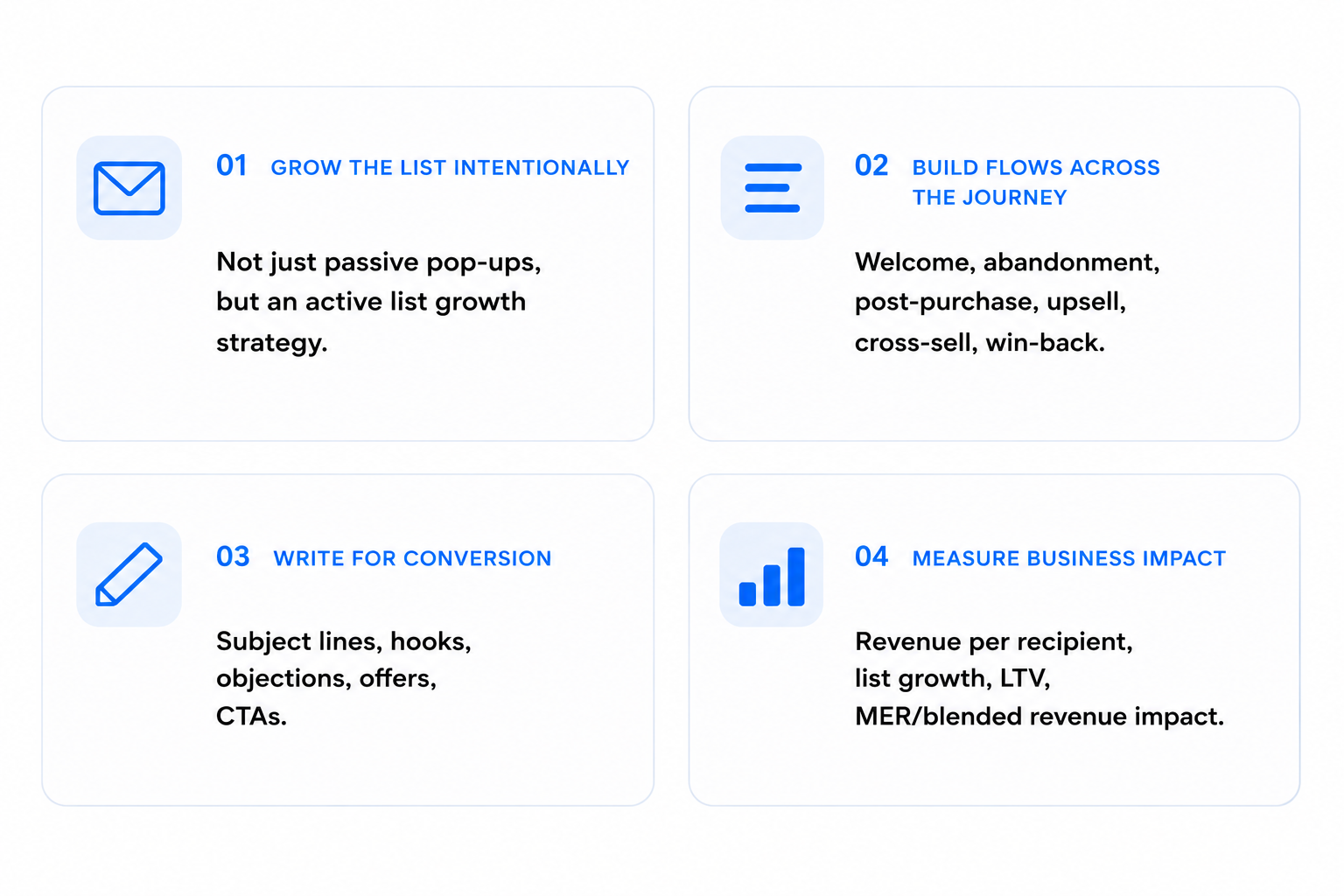
It requires treating the email list as a strategic asset and investing in its growth actively, not just capturing whoever lands on the site. It requires building flows that are genuinely sophisticated, not just a welcome email and an abandoned cart reminder. It requires copy written to convert, not just copy written to communicate. And it requires a measurement framework that connects email activity to business outcomes in a way that informs decisions.
None of this is technically complicated. But it does require treating email with the same strategic seriousness that you bring to paid media. Most brands don't, and the gap in their results reflects it.
If your email revenue is below 20 percent of total revenue and you have a list of meaningful size, the gap between where you are and where you could be is almost certainly an execution problem, not a channel problem. The audience is there. The purchase intent is there. The question is whether your email program is built to capture it.
That's a problem worth solving, and the returns compound faster than most brands expect once the right foundations are in place.