
Paid Media
When to Fire Your Agency: Signs Your Accounts Are Being Managed, Not Scaled
Your agency is reporting on what happened. Not planning what comes next. Here is what that costs you.

Your agency is reporting on what happened. Not planning what comes next. Here is what that costs you.

Most brands don't fire their agency because performance is obviously bad. They fire them 12 months too late, after a slow erosion of results that everyone explained away with market conditions, iOS changes, or increased competition.
This article is not about bad agencies. It's about a specific and common problem: agencies that are competent at managing accounts but not built to scale them. The difference matters more than most brands realise.
A management mindset looks like this: keep the account stable, protect ROAS, avoid big swings, report on what happened last week.
A scaling mindset looks like this: find the next level of growth, test aggressively, reallocate budget based on signal, push into new creative territory, accept short-term inefficiency in exchange for long-term gains.
Both can produce decent looking reports. Only one actually moves the business forward.

A good growth partner must protect measurement quality, control risk, maintain operational discipline, and understand what is already working.
The difference is that management protects the current system, while scaling expands what the system is capable of producing.
The best partners can do both.
The next stage of growth may come from improving conversion rate, changing the offer, increasing creative production, entering a new market, improving customer retention, or fixing the measurement system.
A strong growth partner should know when paid media is the main lever and when it is not.
Sometimes the most valuable thing an agency can say is: “The ad account is no longer the biggest constraint.”
Your meetings are mostly reporting, not strategy. If your weekly or monthly calls are focused on what the numbers were rather than what you're going to do differently, that's a signal. Reporting is not a strategy. If you're not leaving calls with a clear plan for what's being tested and why, something is missing.
Scaling on paid media requires a constant stream of new creative hypotheses.
That does not mean changing the opening line, swapping the creator, or producing five slightly different versions of the same ad. It means testing new customer motivations, problems, product use cases, formats, messages, offers, and levels of awareness.
If your agency has been running the same underlying concepts for months, your account may still look active, but it is effectively in maintenance mode.
A scaling partner should be able to explain what has been learned from previous tests, what the next hypotheses are, and how those learnings are shaping the wider creative strategy.
There is no clear framework for when to scale spend. Being cautious with budget is not automatically a problem. There are valid reasons not to scale, including contribution margin, inventory, fulfilment capacity, lead quality, cash flow, or declining marginal efficiency.
The warning sign is when your agency cannot clearly explain what conditions would justify increasing spend.
They should be able to tell you:
If the answer is always “the account is not ready,” but there is no concrete plan for making it ready, the agency may be protecting stability rather than pursuing growth.
You're doing more internal work than you expected. Good agencies reduce your operational burden. If you're regularly pulling data yourself, chasing updates, or filling in strategic gaps that should be covered, the partnership is not working as it should.
Results are flat but the relationship feels fine. This is the most dangerous sign. When an agency is likeable and responsive but growth has plateaued, it's easy to confuse a good relationship with a productive one. Comfort is not the same as progress.
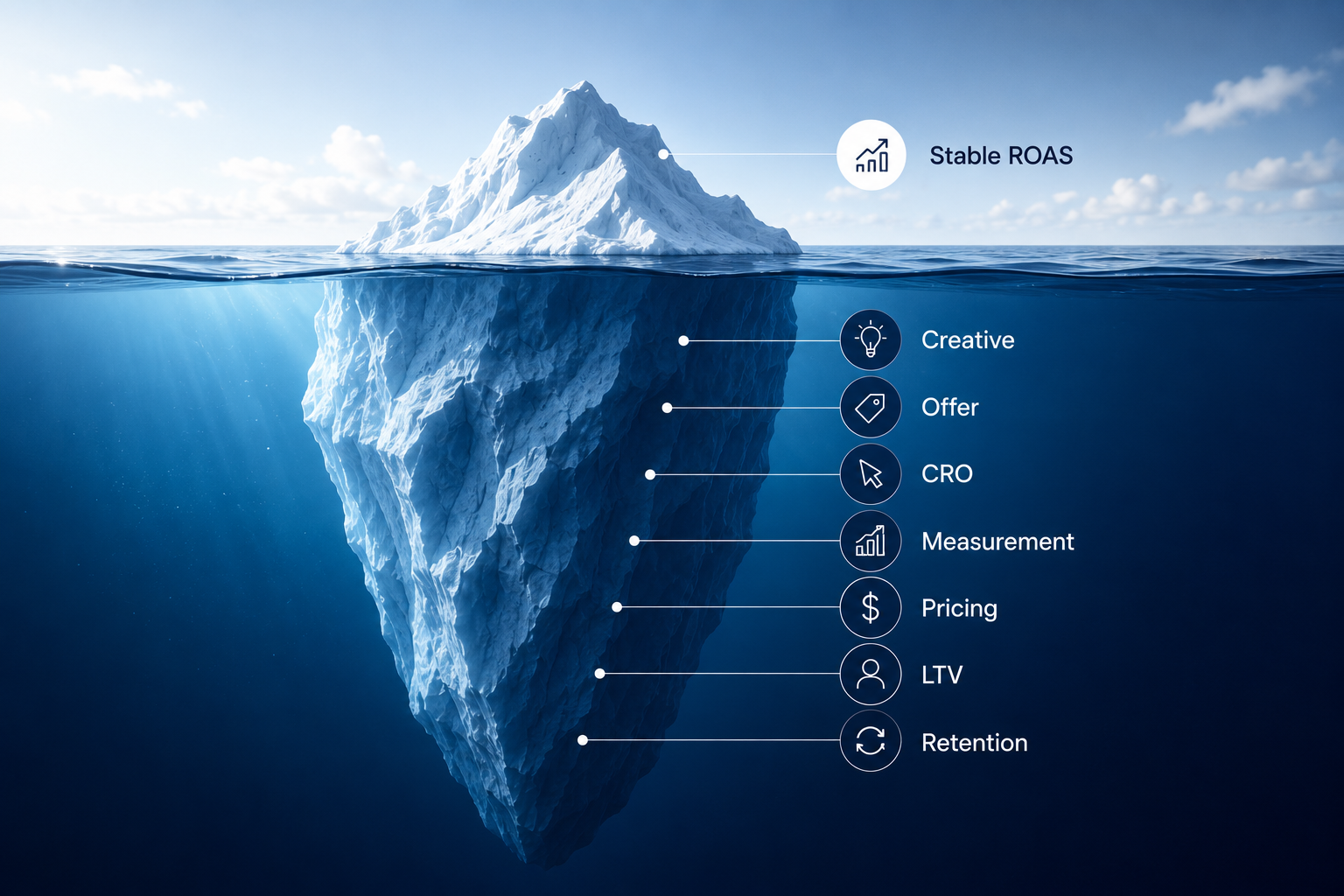
When performance slows, the answer is always another campaign structure, bidding strategy, audience test, or budget adjustment.
But the constraint is not always inside the ad account.
Sometimes the real issue is creative production, the offer, landing-page conversion rate, inventory, pricing, customer retention, or the economics of acquiring the next customer.
A growth partner should help identify the actual constraint, even when the answer sits outside the service they were originally hired to provide.
For example, we have seen brands repeatedly restructure campaigns because spend could not increase without efficiency declining. But the real constraint was not campaign structure. The brand was producing too few genuinely new creative concepts, using an offer that had lost momentum, and sending traffic to a landing page that had not evolved with the business.
In that situation, more media-buying changes would only create activity. They would not create growth.
Firing an agency is a disruption. Before you do it, it's worth being direct about what's not working. Not in a vague "we need to see better results" way, but specifically. What tests should have happened that didn't? What budget reallocation was avoided? What creative directions were never explored?
Sometimes this conversation unlocks a gear the agency had but wasn't using. More often, it confirms that their ceiling is lower than your ambition.
When evaluating a new partner, ask questions that reveal how they think:
The quality of the answers matters more than the confidence of the pitch.
A strong partner should be able to form a clear hypothesis about the business, explain what evidence would confirm it, and show how they would act on what they learn.
Ask them to show you a specific example. What was the situation, what did they change, what happened to growth. If the answer is vague or heavy on process and light on outcomes, that tells you something.
The right partner will push back on your current setup. They'll identify what's broken before you ask them to. They'll have a point of view on where the growth is and what it will take to get there. That's not a sales pitch. That's what strategic partnership actually looks like.
If your agency's primary goal is to protect what's already working, you may never discover what the business is capable of.
Scaling requires more than keeping campaigns stable. It requires identifying the next constraint, challenging assumptions, testing meaningful changes, and accepting that some short-term inefficiency may be necessary to create long-term growth.
The right partner will not only manage the current systems well.
They will help you build the next one.