
Paid Media
Full-Funnel or Bust: Why Bottom-Funnel-Only Thinking Caps Your Growth
If retargeting and branded search are your whole strategy, you are not growing. You are running out of future buyers.
If retargeting and branded search are your whole strategy, you are not growing. You are running out of future buyers.

If you ask most brands where they're getting their best ROAS, the answer is almost always the same. Retargeting. Branded search. Bottom-funnel campaigns targeting warm audiences who are already close to buying.
These campaigns work. That's not the problem. The problem is what happens when they become the entire strategy.
Bottom-funnel-only thinking is one of the most common reasons brands plateau. It feels safe because the numbers look good. But it's a ceiling, not a foundation, and eventually the math stops working.
It usually starts with good intentions. You find what works, you put more money behind it, and you protect it. Retargeting converts well, so you expand retargeting. Branded search is efficient, so you increase branded search budgets. Upper funnel campaigns look expensive and messy by comparison, so you cut them or never build them in the first place.
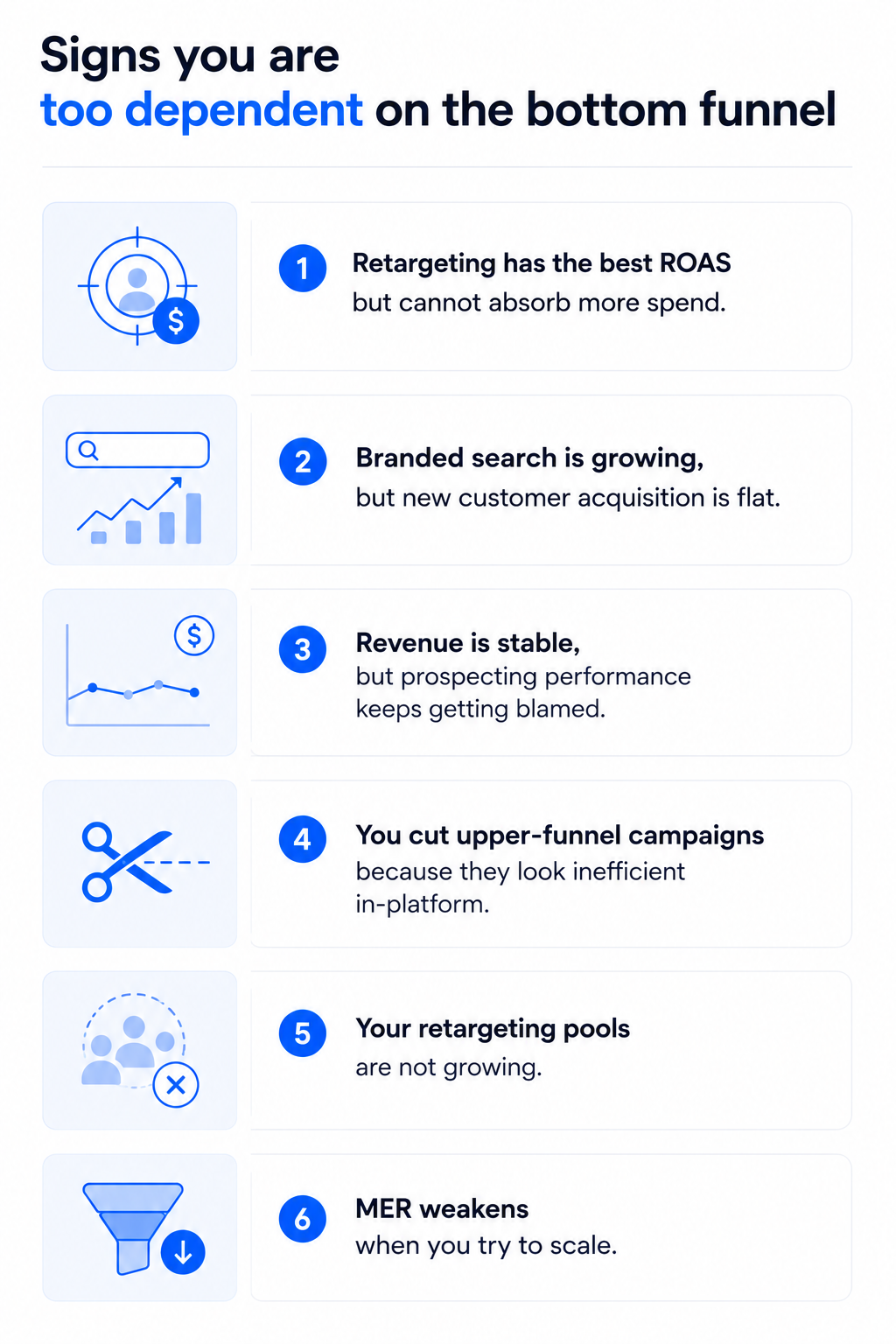
Over time, your paid media strategy becomes almost entirely focused on converting people who were already going to buy. You're harvesting existing demand rather than creating new demand. Revenue holds steady, but growth slows. New customer acquisition drops. And when you try to scale spend, there simply aren't enough warm audiences to spend against.
A brand might see excellent ROAS from retargeting and branded search, so it keeps moving budget there. For a while, the numbers look better. But the brand is now spending more money converting the same limited pool of people, while fewer new prospects are entering the system.
The dashboard looks efficient. The business is quietly running out of future buyers.
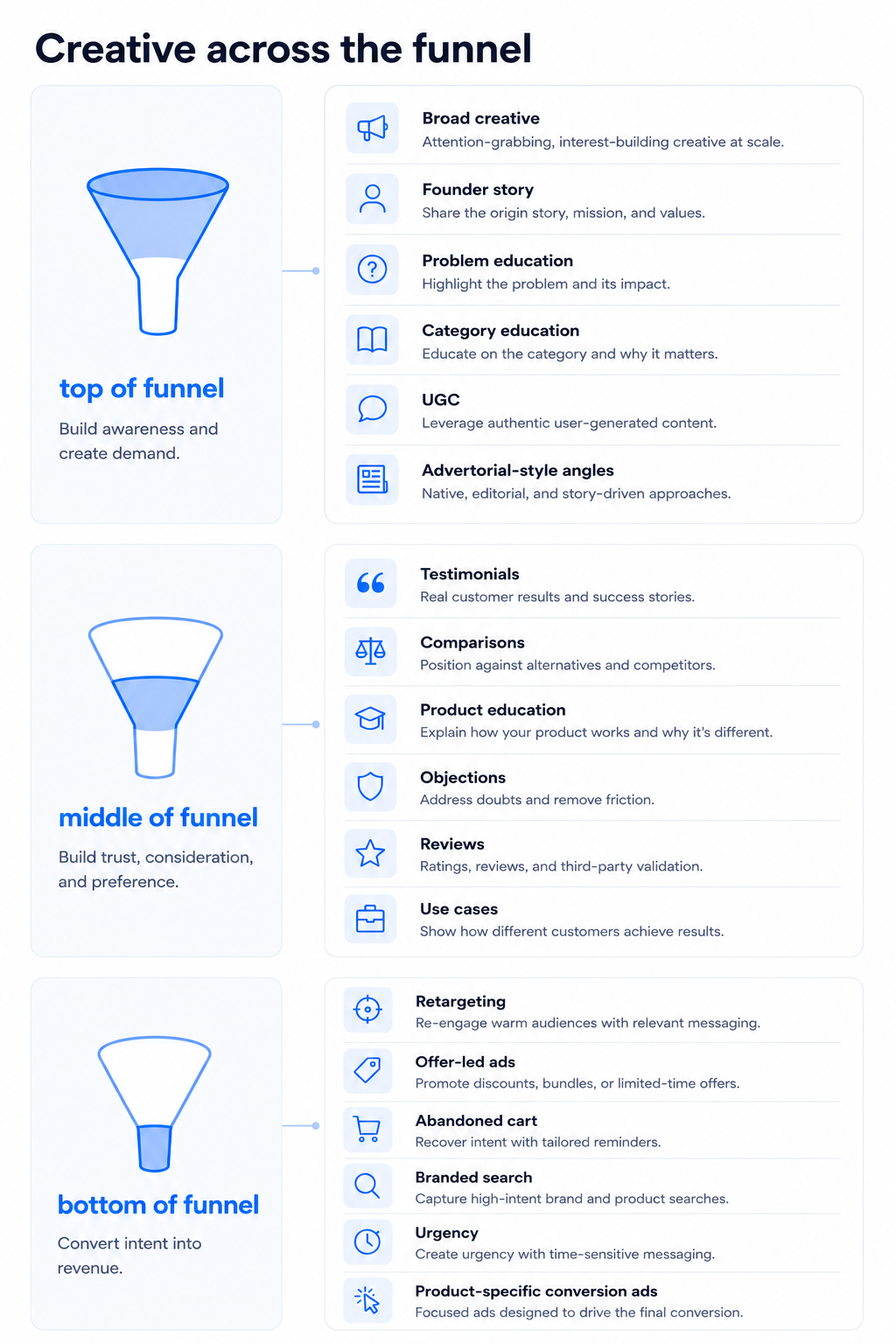
A full funnel is not about running ads at every stage for the sake of it. It's about understanding that different stages of the customer journey require different messages, different creative approaches, and different success metrics.
At the top of the funnel, you're talking to people who don't know you yet. The goal is not conversion. It's awareness and education. You're building the pool of future buyers that your bottom-funnel campaigns will eventually convert. Without this investment, that pool shrinks over time.
In the middle of the funnel, you're talking to people who know you but haven't bought yet. They need more information, more proof, more reason to move forward. This is where strong creative work, social proof, and offer clarity make a real difference.
At the bottom of the funnel, you're talking to people who are ready to buy. This is where conversion-focused campaigns live, and where most brands over-invest relative to the stages above.
When you neglect the top and middle of the funnel, the bottom funnel eventually runs out of road. Warm audiences get smaller as you convert them and fail to replace them with new prospects. Retargeting pools shrink. Performance drops. You increase spend to compensate and efficiency falls further.
This is the plateau most brands hit and struggle to diagnose correctly.
The symptoms show up at the bottom of the funnel, but the cause is at the top.
The shift to full-funnel thinking rarely happens all at once. It starts with accepting that some of your budget needs to go toward activity that won't show an immediate return.
A practical starting point is to look at your new customer acquisition rate over the last six to twelve months. If it's flat or declining while overall revenue holds, that's a signal that your bottom funnel is working but your top funnel is starving it of new prospects.
From there, the question is how much to invest at each stage. There's no universal answer, but a useful principle is this: the budget you put into awareness today is what funds your retargeting pool six months from now. Think of it as an investment with a delayed return, not a cost with no return.
Brands that build genuine full-funnel strategies stop being dependent on warm audiences. They create a consistent flow of new prospects moving through the system. Bottom-funnel performance stabilises because it's being fed properly. Scaling becomes possible because there's always more audience to work with.
The metrics also change. You stop obsessing over the ROAS of individual campaigns and start looking at the health of the whole system. MER improves. New customer rate improves. And the ceiling that felt fixed starts to move.
At the full-funnel level, the question is not “did this campaign produce immediate ROAS?” The question is “is the system creating more future customers than it consumes?”
If your paid media strategy is mostly retargeting and branded search, you're not running a growth strategy. You're running a harvesting strategy. It will work until it doesn't, and by the time it stops working, you'll have lost months of compounding growth you can't get back.
The brands that scale consistently invest in the full funnel before they need to, not after the bottom falls out.