
Creative Strategy
Your Creative Approval Process Might Be Your Biggest Paid Media Problem
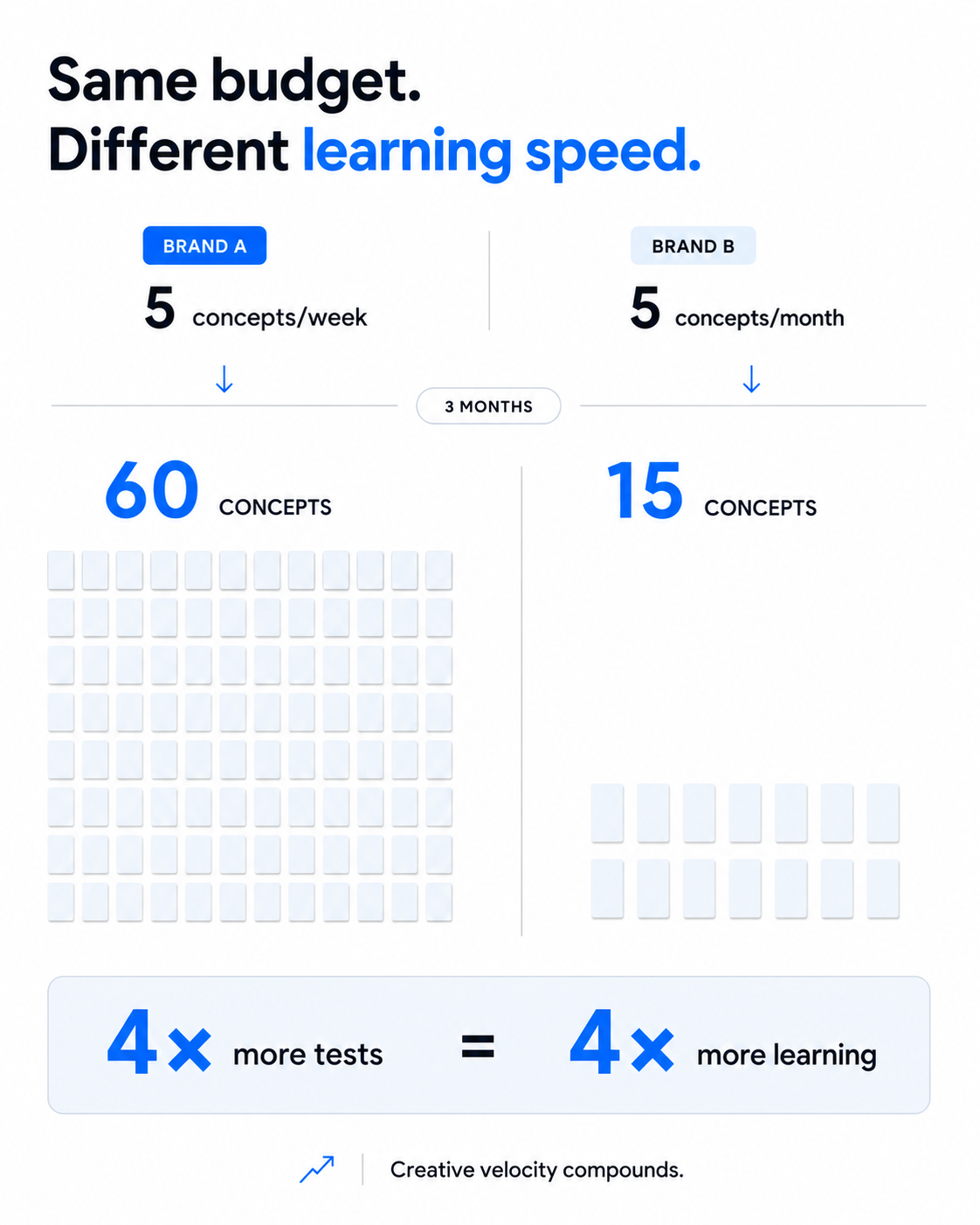
Brand A tested 60 concepts in 3 months. Brand B tested 15. Same budget. The only difference was the approval process.
Brand A tested 60 concepts in 3 months. Brand B tested 15. Same budget. The only difference was the approval process.

Most conversations about paid media performance focus on targeting, bidding, or budget. Creative is acknowledged as important, but the operational side of creative, specifically how fast you can get new concepts tested and live, rarely gets the attention it deserves.
Slow creative approvals are one of the most common and most overlooked reasons brands can't scale. It's not a glamorous problem. It doesn't show up cleanly in your ad account data. But it compounds quietly and eventually becomes the ceiling on everything else you're trying to do.
Imagine two brands with the same budget and the same media buying setup.
Brand A gets five new creative concepts live every week. Brand B gets five new concepts live every month because every asset needs multiple rounds of approval.
After three months, Brand A has tested around 60 concepts. Brand B has tested 15. Even if their teams are equally talented, Brand A now has four times more learning. That learning compounds.
Paid media at scale is essentially a testing machine. You form a hypothesis about what might resonate with your audience, you build the creative, you run it, you learn from it, and you use that learning to inform the next test. The faster you can complete that cycle, the faster you learn, and the faster you grow.
When approvals slow that cycle down, everything slows with it. A creative concept that takes three weeks to get approved and live has already lost time that can't be recovered. The learning comes late, the iteration comes later, and meanwhile you're running the same ads for longer than you should.
The direct cost is straightforward. Fewer tests per month means less data, which means slower optimisation and slower scaling. If a competitor is running twice the number of creative tests you are, they're learning twice as fast. Over six months that gap becomes significant.
The indirect cost is harder to see but just as real. When creative production slows down, teams start protecting the assets they have rather than pushing for new ones. Winning ads run too long. Audience fatigue. Performance drops gradually, and because there's no single moment of failure, it's easy to blame external factors rather than the real cause.
There's also a morale cost. Creative teams and agency partners who consistently see their work delayed or overridden without clear reasoning eventually stop bringing their best ideas. The process becomes about getting through approvals, not about producing work that converts.
In founder-led businesses, the bottleneck is often not lack of ideas or lack of effort. It is that too many decisions still need to pass through the founder. Every piece of creative needs sign-off, feedback loops get longer, and personal preference can start to override performance data.
In larger organisations, the bottleneck is usually process. Multiple stakeholders, legal reviews, brand guidelines that weren't built with performance creative in mind, and approval chains that were designed for a different era of marketing. The result is the same: slow velocity, slow learning, slow growth.
The solution is not to remove oversight. It's to make the approval process faster and more structured so that creative can move at the speed the channel requires.
Start by separating brand guardrails from performance decisions. There are things that genuinely need sign-off, brand consistency, legal compliance, factual accuracy. And there are things that should be decided by data, hooks, formats, angles, offers. Mixing these two categories in the same approval process is where most of the friction lives.
Set clear turnaround expectations. If creative needs to be reviewed and approved within 48 hours to keep the testing pipeline moving, that needs to be an explicit agreement, not an assumption. When timelines are vague, they slip.
Build a testing brief that pre-approves the direction. If you've agreed upfront on the creative territories being explored, individual executions need less scrutiny. The decision has already been made at the strategic level. Execution is just execution.
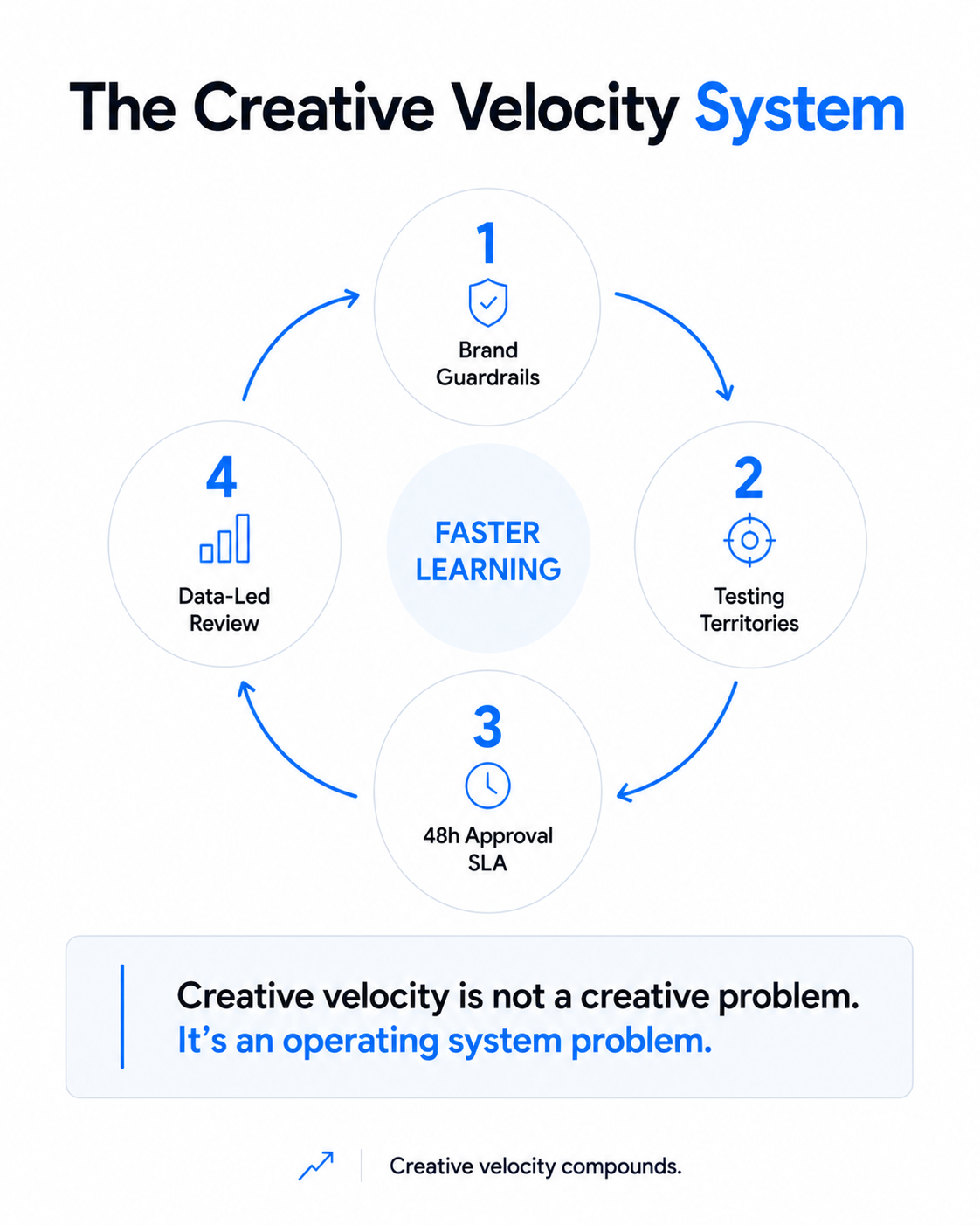
The 4-part creative velocity system:
Trust the data more than personal preference. If a creative concept feels uncomfortable but the early data is strong, that discomfort is usually a signal worth paying attention to, not a reason to pull the ad. The audience is telling you something.
Creative velocity is a competitive advantage. Brands that can test fast, learn fast, and iterate fast will consistently outperform brands that can't, regardless of budget. It's one of the few areas where a smaller brand can genuinely compete with a larger one.
If your creative approval process is adding weeks to your testing cycle, that's not an operational inconvenience. It's a growth problem, and it deserves to be treated as one.
The brands that win on paid media are not always the brands with the biggest budgets. They are often the brands with the fastest learning loops.