

Measurement and Analytics
Why ROAS Is Lying to You When You Are Trying To Scale
Your ROAS looks great. So why is revenue flat? The metric you trust most might be the one holding you back.
Your ROAS looks great. So why is revenue flat? The metric you trust most might be the one holding you back.

ROAS is the metric most brands live and die by. It's clean, it's simple, and it shows up in every report. The problem is that optimising for ROAS is one of the most reliable ways to cap your own growth.
This is not a contrarian take. It's something that becomes obvious once you try to scale past a certain point and find that chasing ROAS efficiency is exactly what's holding you back.
Your ROAS breaks as a decision-making metric during scale and it limits your growth.
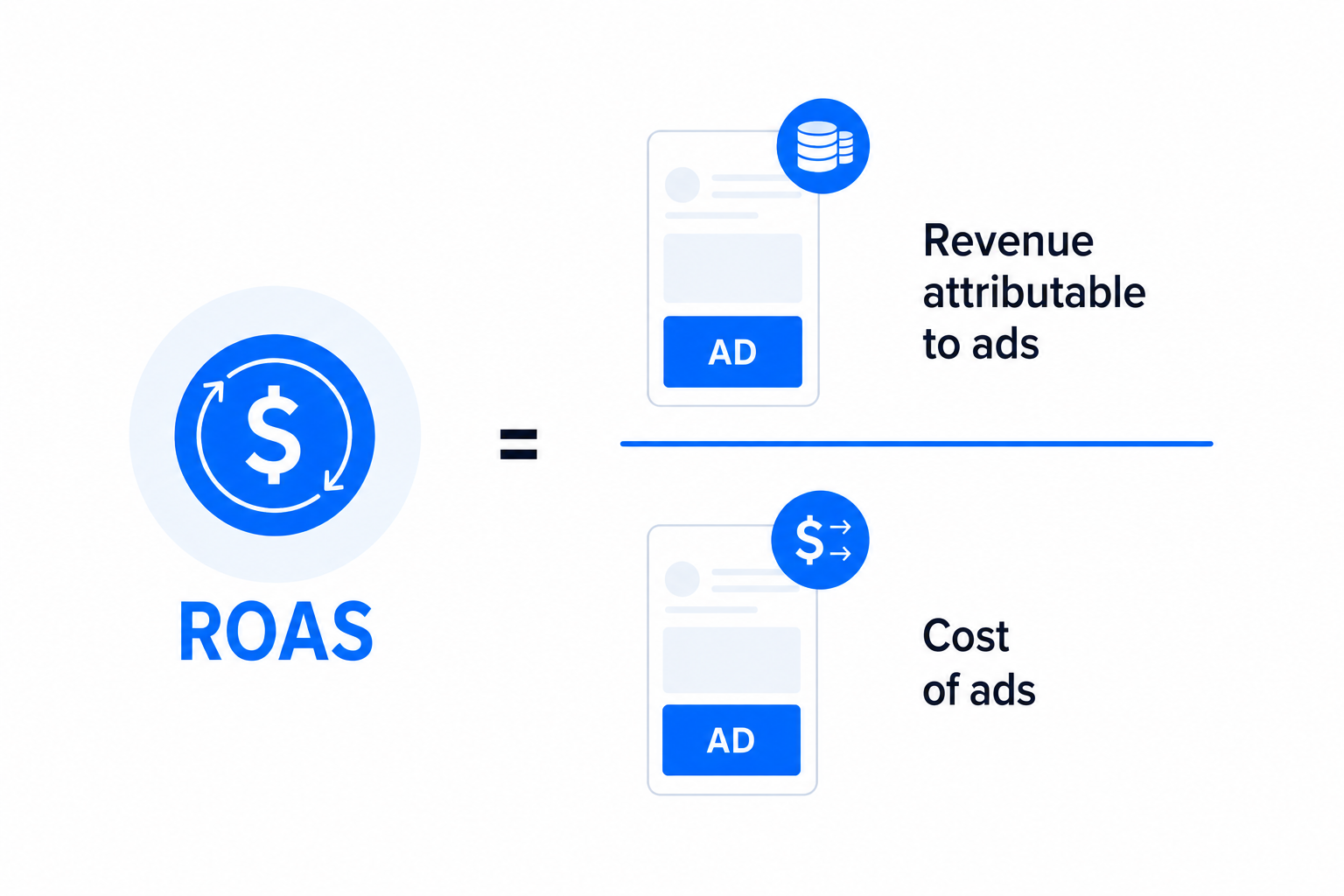
ROAS measures the relationship between ad spend and attributed revenue. On the surface that sounds useful. In practice it has a few significant problems.
It rewards the easy wins. High ROAS usually comes from retargeting warm audiences, bidding on branded keywords, and converting people who were already close to buying. These are valuable, but they are not growth. They are the harvesting of demand you already created, not the creation of new demand.
It works against scaling. When you increase budget and move into colder audiences, your ROAS will almost always fall in the short term. If ROAS is your primary target, every push for growth looks like a step backward. So you retreat, protect the number, and growth stalls.
It ignores the full picture. ROAS as reported in your ad platform does not account for organic revenue, email revenue, or the delayed effect of upper funnel activity. A customer who saw a Meta ad, left, received an email, and bought three days later may not show up in your ROAS at all, or may be attributed multiple times across channels.
For example, a brand spending $100,000 at a 4x ROAS might feel healthier than a brand spending $300,000 at a 2.5x ROAS. But if the second brand is acquiring more new customers, growing total revenue, and maintaining a sustainable CAC to LTV ratio, it may be in a much stronger position.
The problem is not that ROAS went down. The problem is assuming that lower ROAS automatically means worse overall performance.
If ROAS is not the answer, what is? The brands that scale consistently tend to focus on a different set of numbers.
MER, or marketing efficiency ratio, looks at total revenue divided by total marketing spend. It's blunt but honest. It captures the full picture of what your marketing is producing without the distortions of platform attribution. When MER is healthy and improving, you're growing efficiently. When it drops while ROAS holds, something is wrong with the broader system.
CAC by cohort tells you what it actually costs to acquire a customer, and how that changes over time as you scale. A rising CAC is not always a problem if LTV is rising with it. A rising CAC alongside flat LTV is a serious warning sign.
LTV to CAC ratio is the number that tells you whether your growth is sustainable. If you're acquiring customers for more than they're worth over their lifetime, no amount of ROAS optimization will save the business. If the ratio is strong, you have room to be aggressive with acquisition spend in a way that pure ROAS thinking would never allow.
New customer acquisition rate tracks how many of your purchases are coming from first time buyers. A healthy paid media program should be growing this consistently. If your revenue is holding but the new customer rate is flat or falling, you're living off your existing base and paid media is not doing its job.
The shift from ROAS to these metrics changes how you make decisions in meaningful ways.
You become willing to accept lower efficiency at the top of the funnel because you understand what it produces downstream. You stop killing campaigns that look inefficient in platform but are driving real new customer growth. You start making budget decisions based on what the business needs, not what makes the dashboard look good.
This is not about ignoring efficiency. It's about measuring it correctly.
ROAS is not useless. It is useful as a diagnostic metric. The mistake is treating it as the main target for growth.
If you don't have clear visibility into MER, CAC, and LTV right now, that's the first problem to solve. Not because the data will immediately change your strategy, but because without it you're making scaling decisions based on incomplete information.
Once you have the numbers, the question changes from "how do we protect ROAS" to "how much can we invest in growth before it stops being profitable." That's a much more interesting question, and it's the one that actually leads somewhere.
That is the difference between managing ads and managing growth.
If your reporting still starts and ends with platform ROAS, you may not have a performance problem. You may have a measurement problem.