
Creative Strategy
Testing at Scale: How to Run Creative Experiments Without Burning Budget
You are not testing. You are spending money and calling it a test. Here is the difference.
.png)
You are not testing. You are spending money and calling it a test. Here is the difference.

Every brand running paid media knows they should be testing. Test more creatives. Test new angles. Test different offers. The advice is everywhere and it's correct. The problem is that most brands test in a way that produces noise rather than signal, and then wonder why nothing ever beats the control.
Testing at scale is not about running more ads. It is about running the right experiments, in a way that actually produces something you can learn from. Without that structure, you are not testing. You are spending money and calling it a test.
The most common testing mistake is changing too many variables at once. A new hook, a new visual, a new offer, and a new CTA all in the same ad. When it performs differently from the control, you have no idea which variable drove the difference. The learning is useless because it can't be applied to the next test with any confidence.
The second most common mistake is pulling the plug too early. A creative that looks weak in the first 48 hours is often just waiting for the algorithm to find its audience. Brands that kill ads before they've accumulated enough spend to be statistically meaningful end up with a graveyard of inconclusive tests and no real learning to show for it.
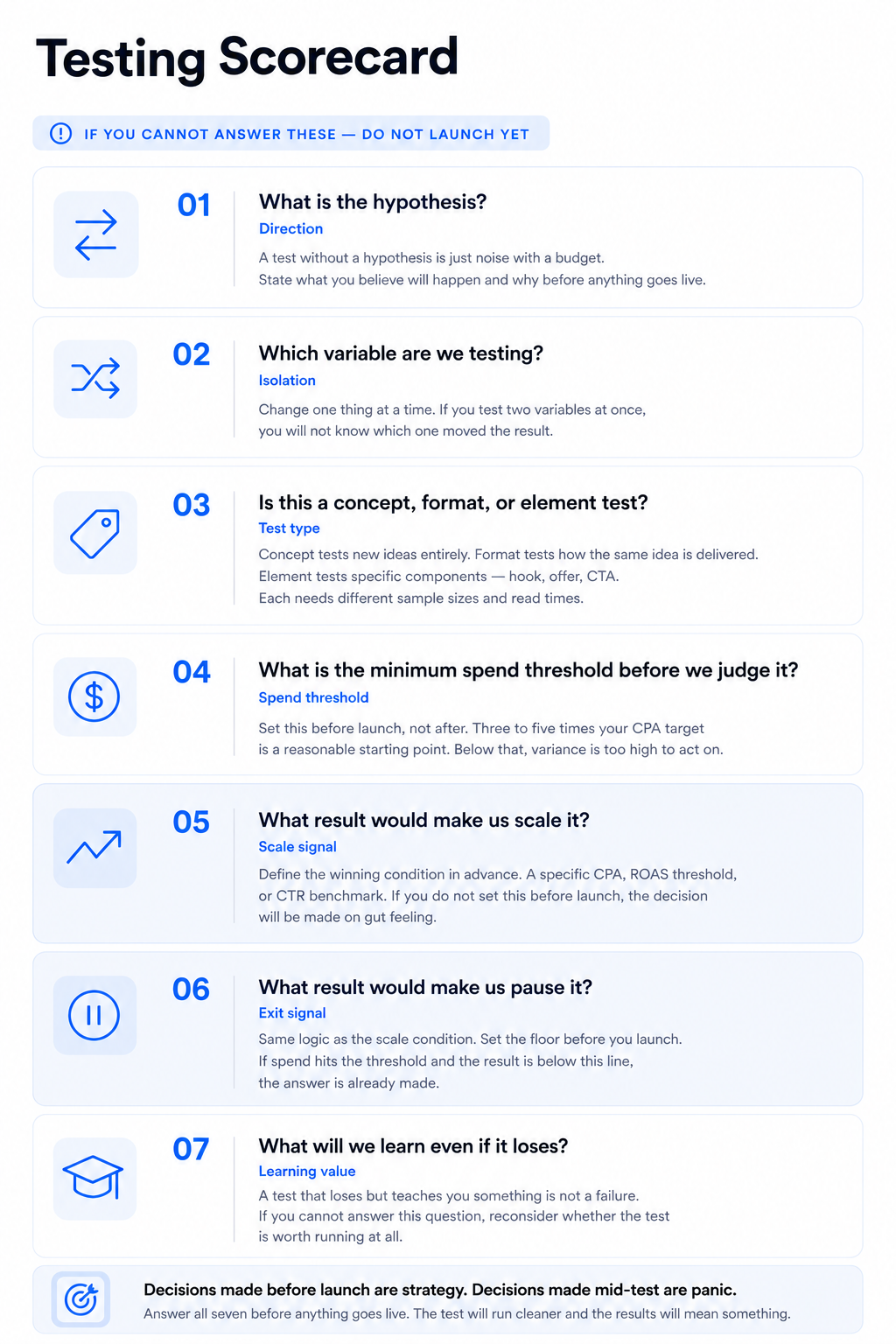
The third mistake is testing without a hypothesis. Launching a new creative because it looks good, or because someone on the team had an idea, is not a test. A test starts with a specific question. What do we believe about our audience? What objection are we trying to address? What angle haven't we explored yet? The creative is the answer to that question, not just a new piece of content.
A structured testing framework starts with a clear creative hierarchy. At the top are concepts, the big strategic bets. A new angle on the problem your product solves. A different protagonist in the story. A completely different hook category. These are the tests that can move the needle significantly if they work.
Below concepts are formats. Once you have a concept that shows promise, you test it across different formats. Static, video, UGC, carousel. You're not changing the idea, you're finding the best way to deliver it.
Below formats are elements. The specific hook line. The thumbnail image. The CTA copy. These are the marginal gains that matter once you've found a concept and format that works. Testing at the element level before you've validated the concept is where a lot of budget gets wasted.
For example, if the concept is “this product saves busy parents time,” the format test might compare UGC, static, and founder-led video using the same core idea. Once one format shows promise, the element tests might focus on the opening hook, thumbnail, or CTA.
That way, each test answers a specific question. You are not just launching more ads. You are learning which idea works, how it should be delivered, and which details improve performance.
Every test needs a minimum spend threshold before you make a decision. What that threshold is depends on your average order value and your typical conversion rate, but the principle is consistent: don't make decisions on data that isn't statistically meaningful.
A useful starting point: set daily budgets at two to three times your CPA target. This gives campaigns enough room to learn without burning through the budget before you have any signal.
For creative thresholds, three to five times your target CPA is a reasonable benchmark. If your target CPA is 50, do not pause or scale a creative until it has spent at least 150 to 250. Below that, the variance is too high and the data is too thin to act on with any confidence.
You also need an upper threshold, the point at which you'll scale a winner. Define this in advance. What ROAS or CPA does a creative need to hit, over what spend level, before you push more budget behind it? Having this defined before you start removes the emotion from the decision.
Testing budget should be a fixed line in your media plan, not whatever is left over after your core campaigns have been spent. Treat it as an investment in future performance, because that's what it is.
A practical allocation is somewhere around 20% of total monthly spend dedicated to testing. This is enough to run a meaningful number of experiments without cannibalising the performance campaigns that are keeping the business running.
Within that testing budget, prioritise concept tests over element tests. The biggest learning comes from finding new angles that resonate, not from discovering that one headline outperforms another by three percent. Concept tests are higher risk but higher return. Element tests are lower risk but the gains are smaller.
The output of every test should be a documented learning, not just a performance report. What was the hypothesis? What did we find? What does this tell us about our audience? What should we test next as a result?
Over time this builds into a genuine creative intelligence asset. You know which angles have been tested and what happened. You know which audience beliefs your creative has validated. You know which directions are worth exploring further and which ones have been exhausted.
This is what separates brands that get consistently better at creative from brands that are always starting from scratch. The testing never stops, but the learning compounds.
Most tests will not produce a winner. That's not a failure of the process, it's how testing works.
The goal is not to win every test. It's to find the winners faster and with less wasted spend than you would by guessing.
A testing framework that produces one strong new concept per month, built on clear hypotheses and structured experiments, will outperform a chaotic approach that launches ten creatives with no clear logic behind any of them.
Structure is not the enemy of creativity. It's what makes creativity scalable.