

Paid Media
The EU Is Not a Mini America. Stop Treating It Like One.
The EU has 27 markets, 24 languages and zero tolerance for copy-paste strategies. Check what brands consistently get wrong.
.png)
The EU has 27 markets, 24 languages and zero tolerance for copy-paste strategies. Check what brands consistently get wrong.

Most US brands entering Europe make the same mistake. They take what worked in the US, translate the copy into a few languages, maybe adjust the currency, and expect the results to follow.
They do not.
We spent years helping US brands scale in Europe. Brands like HexClad and Ridge Wallet. And the pattern we saw, over and over, was the same. A brand that had cracked the US market would enter Europe with confidence, run the same playbook, and wonder why the numbers looked so different.
The playbook was not the problem. The assumption was.
The assumption that Europe is just a smaller, slightly different version of America. It is not. It is 27 different markets, each with its own language, its own shopping behaviour, its own relationship with brands, its own legal requirements, and its own idea of what a good deal looks like.
If you are planning a European expansion and your strategy is to copy what worked in the US, this is worth reading before you spend the budget.
In the US, you have one dominant language, one dominant payment system, one cultural attitude toward shopping, and a consumer base that is broadly comfortable with aggressive direct-to-consumer growth tactics. You can build one funnel, one offer structure, one creative approach, and scale it across a market of 330 million people.
Europe does not work like that.
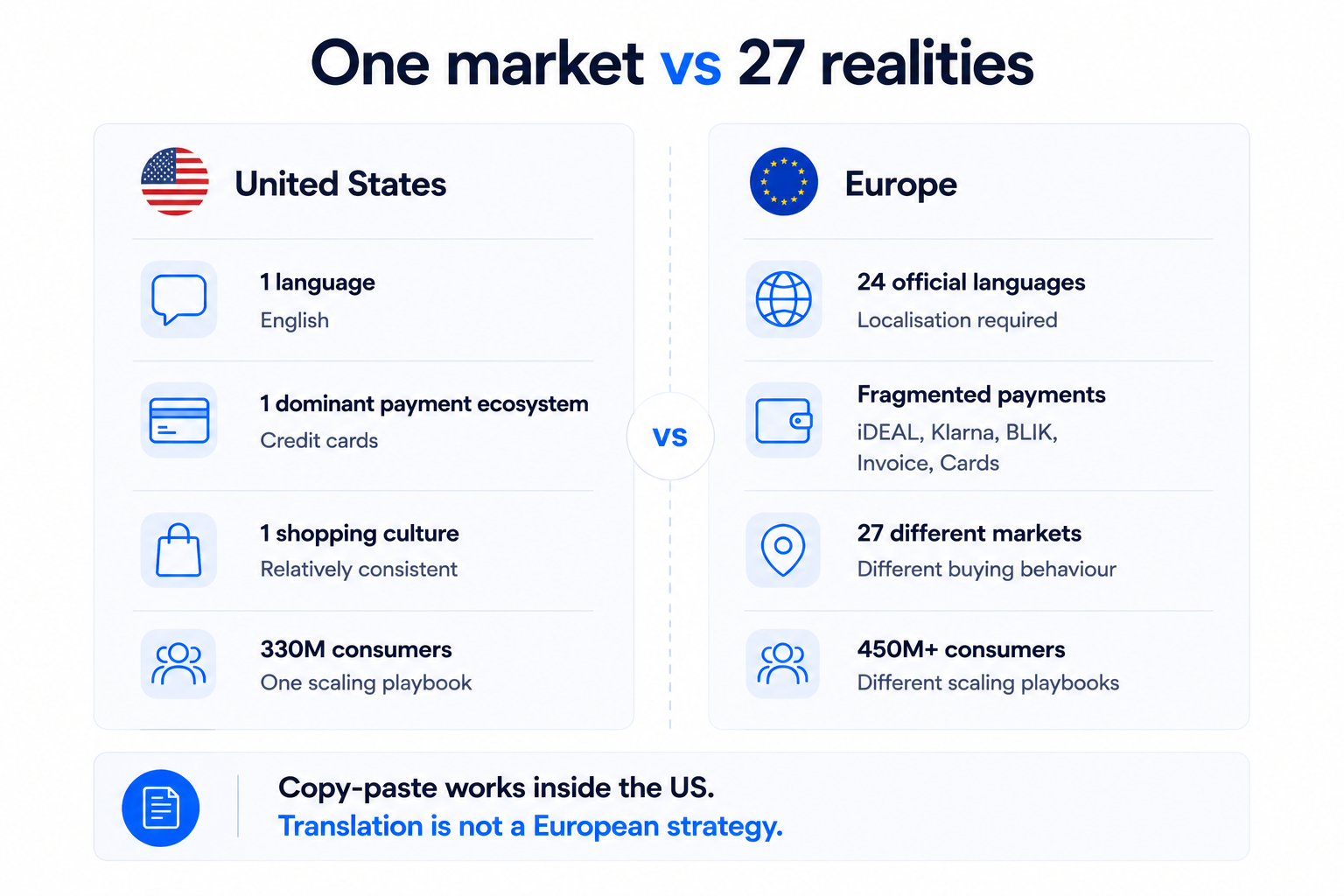
The EU has 27 member states, 24 official languages, and shopping cultures that vary significantly from one country to the next. Germany and Italy are both large European markets. They are also almost nothing alike in terms of how consumers research purchases, what builds trust, what payment methods they prefer, and how they respond to promotional offers.
Treating Europe as a single market is not just a simplification. It is a strategy that will cost you money.
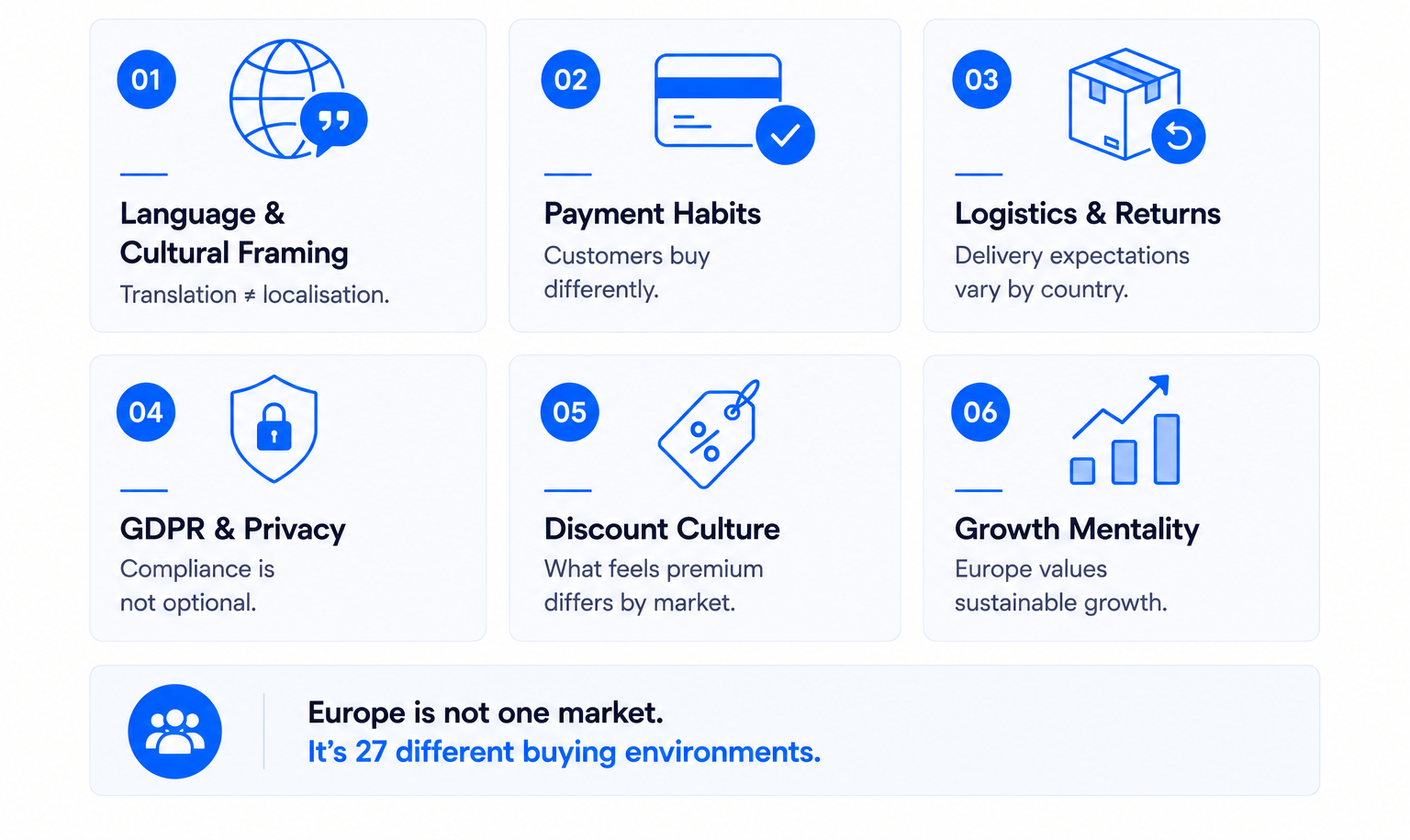
This one sounds obvious, but most brands underestimate it. Running your US copy through a translator and calling it localisation is not localisation. The words might be correct but the tone, the framing, and the cultural references may land completely differently.
German consumers tend to be more sceptical of marketing claims and respond better to direct, factual communication. Italian consumers are more responsive to aesthetics and emotional storytelling. French consumers are famously protective of their language and culture and respond poorly to content that feels like an afterthought.
Creative that converts in California may actively put off a customer in Frankfurt. This is not a translation problem. It is a cultural framing problem.
In the US, credit cards dominate. In Europe, the picture is fragmented. Germany has a strong preference for invoice-based payment, where consumers pay after receiving the goods. The Netherlands has iDEAL, a direct bank transfer system that most Dutch consumers prefer over credit card. In Poland, BLIK. In Sweden, Klarna is native in a way it is not anywhere else.
If you do not offer the right payment methods in each market, you will lose customers at the final step. Not because they do not want the product. Because you did not give them a way to pay that they trust.
Amazon Prime has set a delivery expectation in the US that is very hard to match. In Europe, expectations differ by country. Some markets are comfortable with five to seven day delivery. Others expect two to three days and will not tolerate more.
Returns policies also matter more in some markets than others. Germany, in particular, has a deeply embedded returns culture. Consumers expect to be able to return products easily, and a restrictive returns policy will hurt conversion more than almost anywhere else.
The General Data Protection Regulation applies to any brand selling to European consumers, regardless of where the brand is based. If you are a US brand selling into Germany, you are subject to GDPR. Full stop.
What this means practically: your tracking setup needs to be compliant. Your cookie consent needs to be real consent, not a dark pattern. Your data practices need to match your privacy policy. And your Meta and Google pixel implementation may need to be modified to comply with data transfer rules.
This is not a legal technicality. Non-compliance carries real financial risk. And beyond the legal exposure, European consumers are more privacy-conscious than US consumers on average. A brand that handles data carelessly will lose trust faster in Europe than it would in the US.
In the US, aggressive discounting is a standard growth tool. Percentage off, limited time, buy one get one. US consumers are conditioned to look for deals and respond to urgency.
In parts of Europe, heavy discounting can actually damage brand perception. German and Scandinavian consumers in particular can interpret constant promotional pricing as a signal that the product is not worth full price. Luxury and premium positioning is harder to maintain if you are running aggressive discount campaigns.
This does not mean discounts do not work in Europe. They do. But the threshold for what feels like a good deal versus what feels like desperation is different, and it varies by market.
US DTC culture is heavily influenced by venture-backed growth thinking. Move fast, scale hard, acquire customers aggressively, figure out the economics later. A lot of the playbooks, advice, and case studies that circulate in the US ecosystem reflect this mentality.
European businesses, and to some extent European consumers, tend to be more conservative. The expectation of sustainable, profitable growth is more embedded. Burning money to acquire customers at a loss while you figure out retention is a harder sell, both internally and to customers who are more sceptical of brands that feel like they are growing faster than they should.
This does not mean you cannot grow aggressively in Europe. It means the communication around your brand and your offer needs to be calibrated differently.
The problem is not that American e-commerce thinking is wrong. A lot of it is genuinely useful. The problem is applying it without translation.
Strategic translation means asking, for each market you enter: what is the customer's starting assumption about brands like ours? What do they need to see before they trust us enough to buy? What payment method do they expect? What does a reasonable delivery promise look like? What kind of promotional messaging will land and what will put them off?
These are not questions you can answer from a US-based office. They require either local knowledge or the willingness to do real market research before you spend.
In practical terms, this means a few things.
The most common failure mode we have seen is not that brands try to enter Europe and get completely rejected. It is that they enter, see mediocre results, attribute it to the market not being ready for their product, and pull back.
Often the market was ready. The approach was not.
Germany is one of the largest e-commerce markets in the world. France is not far behind. The Nordics punch significantly above their weight in terms of online spending. These are not small opportunities. But they require respect for the local context, not a copy-paste of a strategy built for a completely different one.
The EU is not a mini America. The brands that understand this before they enter will spend less, learn faster, and build something that actually lasts.