
Creative Strategy
The Creative Ceiling: Why Your Winning Ads Stop Scaling
Your winning ads stop scaling not because the market changed. Because the account ran out of new things to learn.
.png)
Your winning ads stop scaling not because the market changed. Because the account ran out of new things to learn.

Most brands scaling on paid media eventually hit a wall. ROAS drops. CPAs creep up. You increase budget and performance gets worse, not better. The instinct is to blame the algorithm, the season, the market.
Usually it's none of those things. It's your creative.
A creative ceiling happens when your ad account has exhausted the signal from your existing creative pool. The algorithm has seen everything you have, optimised everything it can, and there's simply nothing new to learn from.
A brand might have one winning UGC ad that carried performance for months. It worked because the hook, offer, and audience were aligned. But after enough spend, that same ad has reached most of the people it was likely to convince. The account does not need another slightly different edit of the same concept. It needs a new reason for a new group of people to care.
The good news: it's fixable. But only if you diagnose it correctly.
Performance didn't drop overnight. It rarely does. Here's what it actually looks like:
Your top performers are 6 months old or older. If your best ads haven't changed in months, you're running on borrowed time. Audiences get fatigued, and the algorithm stops finding new pockets of buyers with the same creative.
Your CTR is holding but your conversion rate is falling. People are still clicking, but something is breaking between the ad and the purchase. Often this means the creative is attracting the wrong audience, or the message no longer matches what's on the landing page.
New creatives never beat the controls. You're testing, but nothing sticks. Every new ad underperforms against the same old winner. This usually means your testing process is producing variations, not genuine new concepts.
You're increasing spend but efficiency is dropping. More budget should mean more data and better optimisation, but only if the ad account has enough creative, audience, and conversion signal to absorb it. If it's doing the opposite, the algorithm is being forced to serve ads to people who are increasingly unlikely to convert.
The typical response to declining performance is to tweak. Change the headline. Swap the thumbnail. Try a different CTA. These are variations, not new creative directions, and they rarely move the needle in any meaningful way.
The other common mistake is producing more volume without a clear testing framework. More ads does not mean better signal. If you're launching 20 creatives a month without a structured hypothesis behind each one, you're burning budget on noise.
A variation changes the surface of the ad.
A new concept changes the reason someone should pay attention.
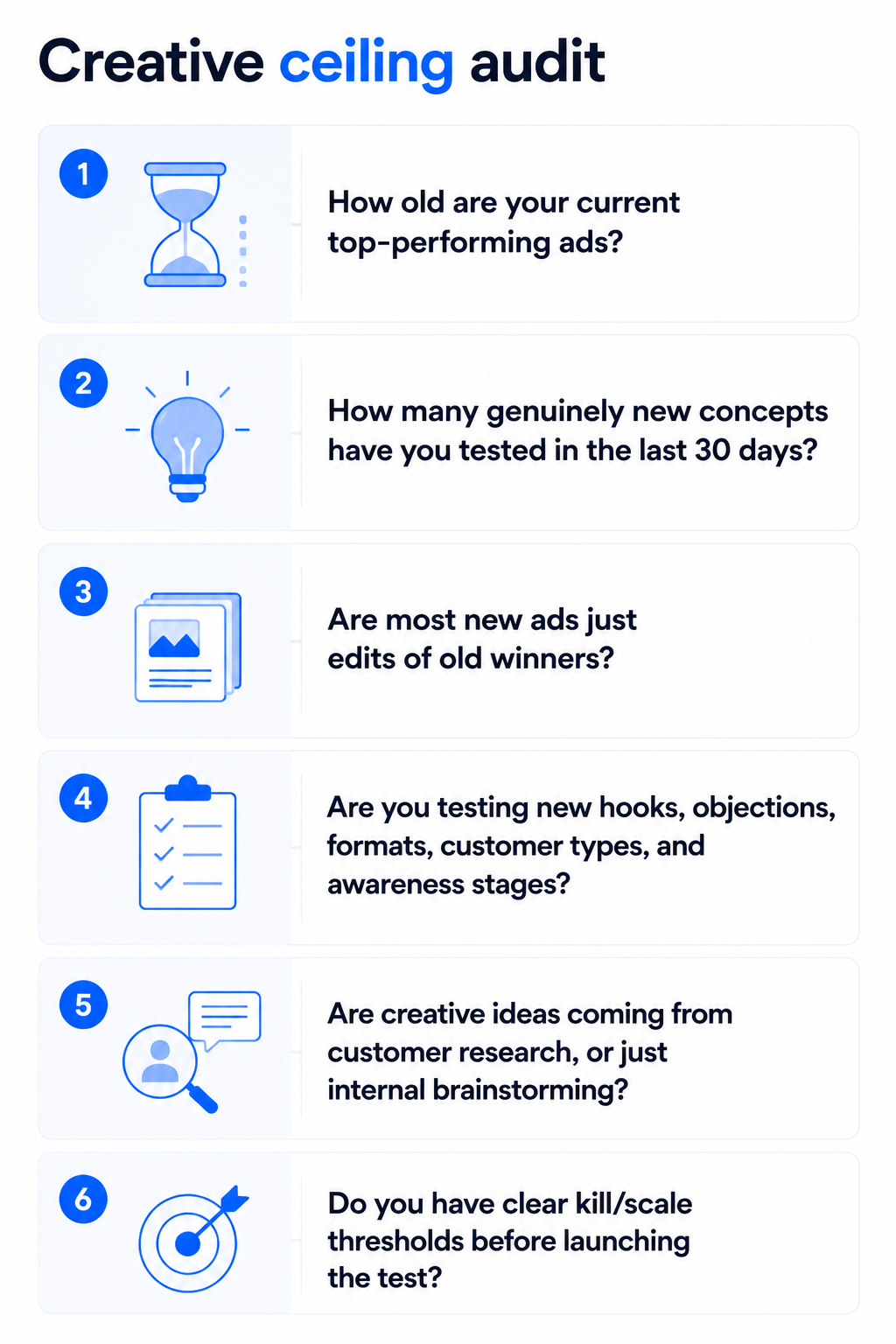
Changing the thumbnail, the caption, or the CTA might help at the margins. But if the underlying angle is the same, the account is not getting much new signal. A real concept test explores a different hook, different pain point, different customer type, different objection, or different stage of awareness.
The brands that push through a creative ceiling do a few things differently.
They treat creative as a research function, not a production function. Every new ad is a test of a specific hypothesis. What angle are we testing? What objection are we addressing? What stage of awareness is this targeting? Without that thinking upfront, you're guessing.
They expand the creative concept, not just the format. Instead of making the same ad in five different sizes, they explore genuinely different angles. A new hook. A different protagonist. A problem framed in a way they haven't tried before. This gives the algorithm real new signal to work with.
They look at what's working outside the ad account. Customer reviews, support tickets, sales call recordings. The language real customers use to describe their problem is often the best creative brief you'll ever have.
They set a clear threshold for when to kill and when to scale. Too many brands hold onto underperforming creative for too long, or kill winning ads too early. A clear decision framework based on spend thresholds and performance benchmarks removes the guesswork.
A creative ceiling is not a sign that paid media is broken for your brand. It's a sign that you've extracted the value from one phase of growth and need to invest in the next one.
Brands that scale past it treat creative production as an ongoing investment, not a one-time cost. They build systems for testing, learning, and iterating, rather than hoping that one great ad will carry performance indefinitely.
The way through a creative ceiling is not more ads. It is better creative thinking, sharper testing, and a system that keeps producing new signals before performance starts to fade.
If your creative hasn't changed significantly in the last 90 days, that's where to start. The problem is most likely not the algorithm. It is that the account has run out of new things to learn.